
Donald Trump’s $90 Medicare Payment: Who Qualifies, When It Will Arrive, and What Seniors Need to Know
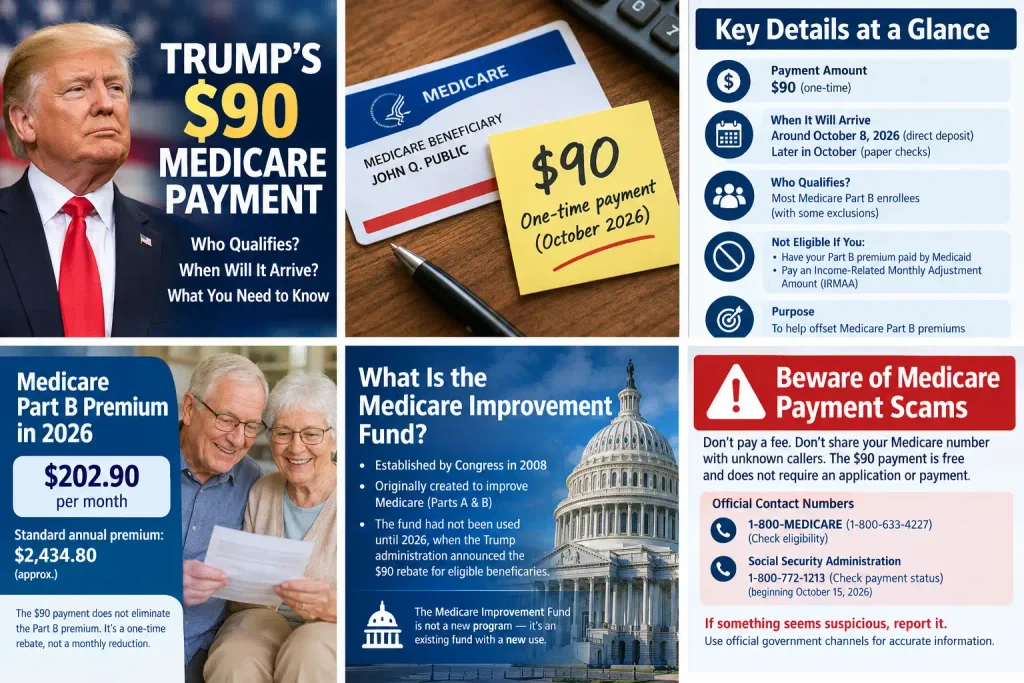
A new Medicare payment announced by President Donald Trump in October 2026 has attracted significant attention among Medicare beneficiaries. The payment is a one-time $90 rebate intended to offset Medicare Part B premiums for eligible beneficiaries.
According to the Centers for Medicare & Medicaid Services (CMS), eligible beneficiaries will receive one $90 payment during October 2026. The White House announced the initiative on October 2, 2026, while CMS published additional eligibility and payment information on October 3.
The payment is connected to the Medicare Improvement Fund, a federal fund created by Congress in 2008. The administration says the fund is being used for the first time to provide a direct financial benefit to Medicare beneficiaries.
It is important, however, to understand exactly what this payment is—and what it is not. The $90 payment is not a new monthly Medicare benefit, not a Social Security increase, and not a permanent reduction in Medicare premiums. It is a one-time payment for eligible Medicare beneficiaries in October 2026.
What Is Donald Trump’s $90 Medicare Payment?
The Trump administration has announced a one-time $90 Medicare Improvement Fund Premium Rebate for certain Medicare beneficiaries.
CMS says the payment is designed to help offset the cost of Medicare Part B premiums. Eligible beneficiaries are expected to receive one $90 rebate in October 2026.
The payment is particularly relevant because the standard Medicare Part B premium for 2026 is $202.90 per month. Some beneficiaries pay more because of income-related charges or other circumstances.
The $90 payment therefore does not eliminate the Part B premium. Instead, for a qualifying beneficiary, it represents a one-time amount intended to offset part of the premium cost.
For example, a beneficiary paying the standard $202.90 Part B premium could receive a $90 rebate. The payment would represent approximately 44% of one standard monthly Part B premium, although the actual financial effect depends on how the beneficiary pays premiums and whether another program pays the premium on the person’s behalf.
When Will the $90 Medicare Payment Arrive?
CMS says most eligible beneficiaries are expected to receive their $90 payment on or around October 8, 2026, generally through direct deposit.
Some beneficiaries will receive a paper check instead. CMS says those checks are expected to be sent later in October.
The White House similarly states that most eligible seniors will receive the payment through direct deposit in early October, while beneficiaries without direct deposit will receive a check at their Medicare-registered mailing address.
This means beneficiaries should not necessarily expect every payment to arrive on exactly the same date.
Expected payment timeline
Payment methodExpected timingDirect depositAround October 8, 2026Paper checkLater in October 2026Payment amount$90FrequencyOne-time paymentPurposeOffset October Medicare Part B premium
CMS also says beneficiaries who want to check their payment status should contact the Social Security Administration beginning October 15, 2026.
Who Is Eligible for the $90 Medicare Payment?
Eligibility is an important part of the program because not every person with Medicare will necessarily receive the payment.
CMS states that most Medicare Part B enrollees are eligible. However, there are specific exclusions.
According to the official CMS guidance, people whose Medicare Part B premiums are already paid by Medicaid are not eligible for the $90 rebate. Beneficiaries who pay an Income-Related Monthly Adjustment Amount (IRMAA) are also excluded from this particular payment.
Therefore, simply having Medicare does not automatically mean that a person will receive the $90 payment.
Basic eligibility information
The payment is generally aimed at Medicare beneficiaries who:
- Are enrolled in Medicare Part B.
- Are responsible for paying their Part B premium.
- Meet the program’s eligibility requirements.
- Are not excluded because their premium is paid by Medicaid.
- Do not pay the applicable IRMAA under the stated exclusion.
Because Medicare circumstances can vary substantially from one beneficiary to another, individuals should verify their own eligibility rather than assuming that every Medicare enrollee qualifies.
Is the $90 Payment the Same as a Social Security Payment?
No.
This distinction is important because many older Americans receive both Social Security and Medicare.
The $90 Medicare Improvement Fund payment is related to Medicare Part B premiums. It should not be confused with a Social Security retirement benefit, Social Security cost-of-living adjustment, or a permanent increase in a person’s monthly Social Security benefit.
Medicare explains that many beneficiaries have their Part B premiums deducted automatically from their Social Security payments.
Because of this automatic deduction, the relationship between Social Security and Medicare can sometimes make Medicare-related payments confusing.
The $90 payment should therefore be understood as a Medicare premium rebate, rather than a new Social Security benefit.
Why Is the Medicare Part B Premium Important?
Medicare Part B generally covers medically necessary physician services, outpatient care and other covered medical services.
For 2026, Medicare lists the standard Part B premium at $202.90 per month. Beneficiaries with higher incomes may pay a larger amount because of the Income-Related Monthly Adjustment Amount.
That means the financial impact of a $90 payment differs between beneficiaries.
For someone paying the standard premium:
$202.90 standard premium − $90 rebate = $112.90
This is only an illustrative comparison of the amounts; it does not mean Medicare will automatically reduce everyone’s monthly premium to $112.90. The $90 payment is a separate one-time rebate.
How Medicare Premiums Normally Work
Most Medicare beneficiaries do not manually send a monthly check for Part B.
Medicare says that most people have their Part B premiums automatically deducted from their Social Security benefit or Railroad Retirement Board benefit.
People who do not receive those benefits may instead receive a Medicare premium bill.
Medicare provides several ways to pay premiums, including:
- Online through a Medicare account
- Medicare Easy Pay
- Online bill payment through a bank
- Mailing a payment
Medicare says premium bills generally must be received by the 25th of the month to be considered on time.
The existence of the $90 rebate does not eliminate these normal Medicare payment rules.
What Is the Medicare Improvement Fund?
The Medicare Improvement Fund is not something created specifically by President Trump in 2026.
Congress established the fund in 2008.
According to the Congressional Budget Office, the original purpose was to make improvements to the original Medicare fee-for-service program, including Parts A and B. The authorized uses have subsequently been modified by Congress.
The CBO reported in 2023 that CMS had not spent money from the Medicare Improvement Fund since its establishment.
That historical fact is important when understanding the 2026 announcement: the Trump administration’s action represents a new use of the fund rather than the creation of an entirely new Medicare program.
How Much Money Was Originally Put Into the Fund?
The history of the Medicare Improvement Fund is complicated because Congress has changed the amount available to the fund multiple times.
The Congressional Budget Office reported that approximately $2.2 billion was initially made available in 2008 for services furnished during 2014. The fund was subsequently modified by multiple pieces of legislation.
The CBO also reported that legislation enacted in 2010 made one of the largest reductions in the amount available to the fund, while other legislation subsequently increased or decreased available funding.
Consequently, it is inaccurate to treat the Medicare Improvement Fund as a simple account containing a fixed amount of money since 2008.
Why Is Trump Using the Medicare Improvement Fund?
The Trump administration says the purpose of the 2026 payment is to put Medicare funds directly toward beneficiaries’ costs.
The White House describes the $90 payment as an effort to reduce the financial burden of Medicare premiums for seniors.
CMS similarly describes the rebate as an effort to make Medicare coverage more affordable for beneficiaries.
The administration has also emphasized broader healthcare-cost initiatives, including changes involving drug pricing and Medicare payment policies.
Those broader initiatives should not be confused with the $90 payment itself. The $90 rebate is a specific October 2026 payment, while other Medicare policy changes operate under separate authorities and timelines.
Is the $90 Medicare Payment Permanent?
No.
The official CMS guidance describes the payment as one $90 rebate in October 2026.
There is no indication in the cited CMS announcement that beneficiaries should expect $90 every month.
This distinction is especially important when evaluating headlines or social-media posts describing the program as a permanent Medicare increase.
A beneficiary receiving $90 in October should not assume that another $90 payment will automatically arrive in November or in subsequent months.
Does the Payment Reduce the Medicare Part B Premium?
The $90 payment is intended to offset the Part B premium, but it should not be interpreted as a permanent change to the statutory or standard monthly Part B premium.
For 2026, Medicare lists the standard Part B premium as $202.90 per month.
The rebate is therefore better understood as a one-time financial offset rather than a permanent reduction in the published Part B premium.
For example:ItemAmount2026 standard Part B premium$202.90/monthOne-time rebate$90Remaining difference for illustration$112.90Recurring $90 monthly reduction?No
The actual way the payment appears to a particular beneficiary can depend on how that person’s Medicare premium is handled.
What If Medicaid Pays Your Medicare Premium?
This is one of the most important exclusions.
CMS specifically says that beneficiaries whose Part B premiums are already paid by Medicaid do not qualify for the $90 payment.
There are several Medicare Savings Programs that can help eligible people with Medicare premiums and other healthcare costs.
For example, Medicare explains that the Specified Low-Income Medicare Beneficiary and Qualifying Individual programs can help eligible beneficiaries pay Part B premiums.
Therefore, someone who receives assistance with Medicare premiums should not assume that the $90 rebate will also be paid directly to them.
What If You Pay IRMAA?
Another important exclusion concerns IRMAA, or the Income-Related Monthly Adjustment Amount.
Higher-income Medicare beneficiaries can pay more than the standard Part B premium.
Medicare uses income information from an earlier tax year to determine whether an individual owes an IRMAA. For 2026, Medicare says the standard Part B premium is $202.90, but higher-income beneficiaries can pay more.
The White House and CMS state that beneficiaries who pay an Income-Related Monthly Adjustment Amount do not qualify for the $90 payment.
This makes the eligibility rules particularly important for people with higher retirement income or other taxable income.
How Does the $90 Payment Relate to Medicare Part A?
The rebate is specifically associated with Part B premiums.
Medicare Part A is hospital insurance, while Part B is medical insurance.
Most people qualify for premium-free Part A because they or their spouse paid Medicare taxes for a sufficient period while working. In 2026, people who do not qualify for premium-free Part A may pay either $311 or $565 per month, depending on their work history.
The $90 payment should therefore not be described as a $90 payment toward every Medicare cost.
It is specifically connected with the Part B premium rebate announced by CMS.
Does Everyone With Medicare Receive $90?
No.
This is one of the most important points for beneficiaries to understand.
The official announcement does not say that every Medicare beneficiary automatically receives $90.
CMS states that most eligible Part B enrollees qualify, but it specifically excludes beneficiaries whose Part B premiums are paid by Medicaid and beneficiaries who pay IRMAA.
Eligibility can therefore depend on an individual’s Medicare and income circumstances.
How Can Beneficiaries Check Their Eligibility?
The White House says beneficiaries can call 1-800-MEDICARE (1-800-633-4227) to check eligibility for the premium rebate.
CMS also provides information about checking payment status.
For payment-status questions, CMS says beneficiaries should contact the Social Security Administration at 1-800-772-1213 beginning October 15, 2026.
Beneficiaries should use official government channels rather than relying on social-media posts, unsolicited emails or messages claiming that a person must pay a fee to receive the Medicare payment.
Beware of Medicare Payment Scams
Whenever a government payment receives widespread attention, scams can become a concern.
Beneficiaries should be cautious if someone contacts them claiming that they need to:
- Pay a fee to receive the $90 payment.
- Provide banking information through an unsolicited message.
- Give a Medicare number to an unknown caller.
- Purchase a gift card to “activate” the payment.
- Send money to receive a larger Medicare payment.
Official Medicare and Social Security contact channels should be used to verify information.
Medicare’s official payment information directs beneficiaries to their secure Medicare account and official Medicare contact channels for premium-related questions.
How Much Is Medicare Part B in 2026?
The standard Part B premium for 2026 is $202.90 per month.
The standard annual premium is therefore:
$202.90 × 12 = $2,434.80
A one-time $90 rebate would equal about 3.7% of that annual standard premium.
This calculation is simply a way of putting the payment into perspective. It does not change the official Medicare premium amount.
Beneficiaries who pay an IRMAA may have a higher premium, but CMS states that people paying IRMAA are excluded from the $90 rebate.
Does the Payment Change Medicare Deductibles?
No.
The $90 rebate should not be confused with a reduction in Medicare deductibles.
For 2026, Medicare lists the Part B deductible at $283.
A Part B premium is the amount paid to maintain Part B coverage. A deductible is the amount a beneficiary generally pays for covered services before Medicare begins paying its share under the applicable rules.
The $90 payment is directed toward the premium rather than functioning as a general deductible credit.
What About Medicare Advantage?
Medicare Advantage is different from Original Medicare, although Medicare beneficiaries enrolled in Medicare Advantage remain part of the Medicare program.
The $90 announcement specifically describes a rebate for Medicare Part B premiums.
Medicare Advantage beneficiaries can have different premium arrangements, including plans with premiums of $0, while the standard Part B premium generally remains relevant to beneficiaries enrolled in Medicare Advantage.
Beneficiaries should therefore verify how their individual Part B premium is handled rather than assuming the $90 payment operates like a Medicare Advantage plan benefit.
Other Medicare Changes Under the Trump Administration
The $90 rebate is only one Medicare-related development during 2026.
CMS has also announced changes involving prescription-drug payment policies.
For example, on September 30, 2026, CMS finalized the Global Benchmark for Efficient Drug Pricing (GLOBE) Model, a five-year mandatory model involving selected Medicare Part B drugs. CMS says the model is scheduled to begin January 1, 2027, and will use international drug-pricing information as part of a new rebate calculation for certain drugs.
CMS has also announced the third cycle of Medicare drug-price negotiations, including the first selection of Medicare Part B drugs for the negotiation program. The negotiated prices from this cycle are scheduled to take effect in 2028.
These policies are separate from the $90 Medicare Improvement Fund payment.
Medicare Costs for 2026
Understanding the $90 payment requires understanding the larger Medicare cost structure.
Part A
For 2026:
- Most beneficiaries pay $0 monthly for Part A.
- People who do not qualify for premium-free Part A may pay $311 or $565 per month.
- The Part A hospital deductible is $1,736 per benefit period.
- Hospital coinsurance applies for longer inpatient stays.
Part B
For 2026:
- Standard monthly premium: $202.90
- Part B deductible: $283
- Higher-income beneficiaries may pay more.
- Late enrollment penalties may apply in certain circumstances.
The $90 rebate relates specifically to the Part B premium rather than all of these Medicare costs.
What Happens If You Do Not Pay Your Medicare Premium?
The $90 payment does not eliminate the normal requirement to keep Medicare premiums current.
Medicare says that people who receive a Medicare premium bill must pay it by the due date. Medicare generally needs to receive the payment by the 25th of the month for it to be on time.
If a bill becomes delinquent and remains unpaid, Medicare warns that a person could lose coverage.
Beneficiaries should therefore not stop making required premium payments simply because they expect a $90 rebate.
Why the Announcement Has Created Confusion
There are several reasons the payment can be misunderstood.
First, the payment is being publicly associated with President Trump, but the money comes through the Medicare Improvement Fund, a fund established by Congress in 2008.
Second, the payment is sometimes described broadly as a “Medicare payment,” which could make it sound like a new monthly Medicare benefit.
Third, many Medicare beneficiaries have their Part B premiums automatically deducted from Social Security, which can make the mechanics of a separate Medicare rebate less obvious.
Finally, Medicare beneficiaries have different premium arrangements. A person paying the standard Part B premium is not necessarily in the same position as someone whose premium is paid through Medicaid or someone who pays IRMAA.
Is This a $90 Monthly Medicare Increase?
No.
The official CMS description is a one-time $90 rebate in October 2026.
Therefore, beneficiaries should not interpret the program as:
- $90 every month
- $1,080 every year
- A permanent increase in Social Security
- A permanent reduction of the Part B premium
- A universal payment to everyone with Medicare
The official information supports describing it as a one-time $90 Medicare Part B premium rebate for eligible beneficiaries.
Frequently Asked Questions
Is Donald Trump giving seniors a $90 Medicare payment?
The Trump administration announced a one-time $90 Medicare Improvement Fund Premium Rebate for eligible Medicare beneficiaries. CMS says the payment is intended to offset Medicare Part B premiums.
Is the $90 Medicare payment monthly?
No. CMS describes it as a one-time $90 rebate in October 2026.
When will the $90 Medicare payment arrive?
CMS says most eligible beneficiaries should receive the payment by direct deposit on or around October 8, 2026. Paper checks are expected later in October.
Who qualifies for the $90 Medicare payment?
Most eligible Medicare Part B enrollees qualify, subject to the program’s eligibility rules. CMS specifically states that beneficiaries whose premiums are paid by Medicaid and beneficiaries who pay IRMAA do not qualify.
How much is Medicare Part B in 2026?
The standard Medicare Part B premium is $202.90 per month in 2026. Higher-income beneficiaries may pay more.
Is the $90 payment a Social Security increase?
No. It is a Medicare Part B premium rebate and should not be confused with an increase in Social Security benefits.
Will everyone with Medicare get $90?
No. The payment has eligibility requirements, and CMS identifies specific exclusions, including beneficiaries whose Part B premiums are paid by Medicaid and beneficiaries who pay IRMAA.
Do I need to apply for the $90 payment?
The official CMS information describes the rebate as being made to eligible beneficiaries and does not describe a general application process. Beneficiaries with questions should contact Medicare through its official channels.
Can I check whether I qualify?
Yes. The White House says beneficiaries can call Medicare at 1-800-MEDICARE (1-800-633-4227) to check eligibility.
Can people who receive Medicaid get the payment?
CMS says beneficiaries whose Medicare Part B premiums are already paid by Medicaid do not qualify for the $90 rebate.
Does the $90 payment reduce the Part B deductible?
No. The payment is intended to offset the Part B premium. The 2026 Part B deductible is separately listed by Medicare as $283.
Is the Medicare Improvement Fund new?
No. Congress established the Medicare Improvement Fund in 2008. The Congressional Budget Office has documented its legislative and funding history.
Is the $90 payment guaranteed every year?
The current CMS announcement describes a one-time $90 payment for October 2026. It does not establish an annual recurring $90 payment.
Final Takeaway
The 2026 Medicare payment associated with President Donald Trump is a one-time $90 Medicare Improvement Fund Premium Rebate for eligible beneficiaries.
The most important facts are:
- Payment: $90
- Type: One-time Medicare Part B premium rebate
- Timing: October 2026
- Most direct deposits: Around October 8, 2026
- Standard 2026 Part B premium: $202.90 per month
- Not a monthly benefit: The $90 payment is one-time
- Not a Social Security increase: It is a Medicare-related rebate
- Medicaid-paid Part B premiums: Excluded
- IRMAA payers: Excluded
- Eligibility questions: 1-800-MEDICARE
- Payment-status questions: Social Security Administration, beginning October 15, 2026
The Medicare Improvement Fund itself dates back to 2008, and the Congressional Budget Office has documented that Congress has repeatedly changed its funding and authorized uses over the years.
For beneficiaries, the practical point is simple: eligible Medicare Part B beneficiaries may receive a one-time $90 payment in October 2026, but it should not be mistaken for a permanent increase in Medicare benefits or a permanent reduction in the monthly Part B premium.